Category: Voices of the Armistice

  • Rutgers in the First World War: Voices of the Armistice—”New Year’s Eve in New York [and] a Couple of Mardi Gras”

    Facebooktwitterredditpinterestlinkedinmail

    November 11, 2018 is Veterans Day and marks the 100th anniversary of the Armistice that ended World War I. To commemorate this centennial, What Exit?  will be featuring letters from Special Collections and University Archives’ Records of the Rutgers College War Service Bureau. This collection features letters from Rutgers students and alumni who served in the First World War, describing their experiences serving in the United States and overseas. Each day between November 1 and 11, Voices of the Armistice posts will share what these Rutgers students from 100 years ago had to say about the moment when peace was declared.
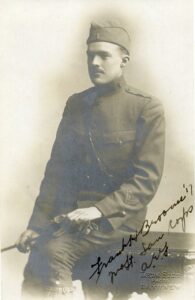
    Photo of Frank Broome in uniform
    Frank Broome

    On November 11, 1918 Frank Broome (class of 1917) was serving in the U.S. Sanitary Corps. as part of the American Expeditionary Forces in France. He felt that nothing could adequately capture the celebration he witnessed when peace was declared.

    “The people over here went just about crazy when the armistice was signed, I should like to tell you something that went on in the cities near here, but with about a hundred moving picture machines and a few thousand phonographs, I think that you might record the doings in only an extremely small spot. It was something like New Years Eve in New York, a couple of mardi gras, a Sunday afternoon at Coney Island and a few other similar gatherings thrown in one and then some. Luckily the weather was fair for it all.”
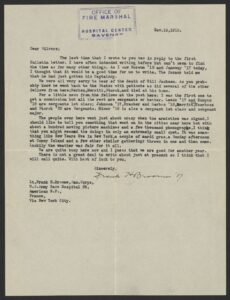
    typed letter
    Letter from Frank Broome describing end of First World War.

    After the war, Broome became an educator and inventor. He died in 1940.


    The Rutgers War Service Bureau was formed in 1917 as a way to keep Rutgers men serving in the war in touch with Rutgers and each other. It was headed by Earl Reed Silvers (class of 1913), who was assistant to Rutgers president William Henry Steele Demarest. Thanks to a grant from the New Jersey Historical Commission, the letters are now available online.

    Be sure to visit What Exit? between November 1 and 11 for new stories and follow highlights on Special Collections and University Archives’ Facebook and Twitter.

    (With assistance from Tara Maharjan. Broome photo from the Rutgers University Biographical Files: Alumni Collection.)

  • Rutgers in the First World War: Voices of the Armistice—”A Kind of Super-Halloween Celebration”

    Facebooktwitterredditpinterestlinkedinmail

    November 11, 2018 is Veterans Day and marks the 100th anniversary of the Armistice that ended World War I. To commemorate this centennial, What Exit?  will be featuring letters from Special Collections and University Archives’ Records of the Rutgers College War Service Bureau. This collection features letters from Rutgers students and alumni who served in the First World War, describing their experiences serving in the United States and overseas. Each day between November 1 and 11, Voices of the Armistice posts will share what these Rutgers students from 100 years ago had to say about the moment when peace was declared.

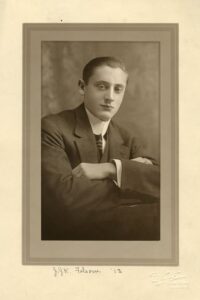
    photograph of Joseph K. Folsom
    Joseph K. Folsom.

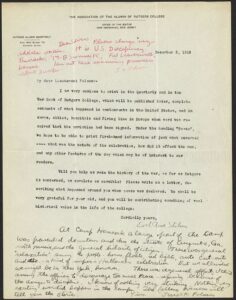
    Joseph K. Folsom (class of 1913) was stationed at Camp Hancock in Augusta, Georgia, on November 11, 1918. When he received War Service Bureau director Earl Reed Silvers’s letter asking for information about “what happened around you when peace was declared.” Folsom wrote a brief paragraph on Silvers’s letter itself saying:

    “At Camp Hancock a large part of the camp was paraded downtown and thro the streets of Augusta, Ga. with music, and the general hilarity of citizens. There was general ‘relaxation’ among the people—horns, floats, red lights, auto cut-outs and etc.—a kind of super-Halloween celebration. But we all wished we might be in New York, however. There was a general effort, I think among the officers to discourage too much peace-rejoicing, because of the danger to discipline. I know of nothing very striking. Nothing very exciting ever did happen in the camps. The fellows overseas will tell you the stories.”

    typed letter with handwritten response.
    Joseph K. Folsom’s response to Silvers’s inquiry about the end of the war.

    After the war, Folsom became a professor of sociology at Vassar College in Poughkeepsie, New York. He died in 1960.


    The Rutgers College War Service Bureau was formed in 1917 as a way to keep Rutgers men serving in the war in touch with Rutgers and each other. It was headed by Earl Reed Silvers (class of 1913), who was assistant to Rutgers president William Henry Steele Demarest. Thanks to a grant from the New Jersey Historical Commission, the letters are now available online.

    Be sure to visit What Exit? between November 1 and 11 for new stories and follow highlights on Special Collections and University Archives’ Facebook and Twitter.

    (With assistance from Tara Maharjan. Folsom photo from the Rutgers University Biographical Files: Alumni Collection.)
  • Rutgers in the First World War: “Voices of the Armistice” November 1–11, 2018

    Facebooktwitterredditpinterestlinkedinmail

    November 11, 2018 is Veterans Day and marks the 100th anniversary of the Armistice that ended World War I. To commemorate this centennial, What Exit?  will be featuring letters from Special Collections and University Archives’ Records of the Rutgers College War Service Bureau. This collection features letters from Rutgers students and alumni who served in the First World War, describing their experiences serving in the United States and overseas. Each day between November 1 and 11, Voices of the Armistice posts will share what these Rutgers students from 100 years ago had to say about the moment when peace was declared.

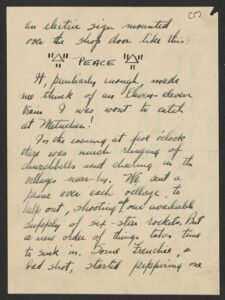
    Joseph K. Folsom (class of 1913), was stationed in Georgia on November 11, 1918 and described a “kind of super-Halloween celebration” with a noisy parade and “general hilarity.” Harry Blue (class of 1918) was stationed in France. He described taking a swooping celebratory flight in which he “missed electrical wires by inches.”

    page from letter describing sign comemmorating declaration of peace on November 11, 1918
    Page from letter by Harry Blue (class of 1915) describing his experiences of the Armistice that ended the First World War.

    The Rutgers War Service Bureau was formed in 1917 as a way to keep Rutgers men serving in the war in touch with Rutgers and each other. It was headed by Earl Reed Silvers (class of 1913), who was assistant to Rutgers president William Henry Steele Demarest. Thanks to a grant from the New Jersey Historical Commission, the letters are now available online.

    Be sure to visit What Exit between November 1 and 11 for new stories and follow highlights on Special Collections and University Archives’ Facebook and Twitter.


What Exit?

News and information about holdings, events, acquisitions, and New Jerseyana at the Department of Special Collections and University Archives, Rutgers University Libraries, New Brunswick

Follow Us

Categories

Recent Posts

Tags

Anglo-Dutch wars cookbooks Cornelius Van Horne digitization Dinah van Bergh Hardenbergh Dutch records Dutch slave owners election cake farm ledgers Frelinghuysen Family Great War Hardenbergh Familie Hebrew herbals Jacob Rutsen Hardenbergh Johannes G. Hardenbergh manuscripts New Brunswick New Brunswick Music Scene Archive New Jersey Dutch NJ Soldiers Pictorial collection Postcard Collection Scarlet and Black Sinclair NJ Cookbook Collection Soujourner Truth Theodorus Jacobus Frelinghuysen Trenton Ukawsaw Gronniosaw Ulster County NY World War I