Category: Rutgers University History

  • Rutgers in the First World War: Voices of the Armistice—”A Pandemonium of Whistles, Sirens, Bells”

    Facebooktwitterredditpinterestlinkedinmail

    November 11, 2018 is Veterans Day and marks the 100th anniversary of the Armistice that ended World War I. To commemorate this centennial, What Exit?  will be featuring letters from Special Collections and University Archives’ Records of the Rutgers College War Service Bureau. This collection features letters from Rutgers students and alumni who served in the First World War, describing their experiences serving in the United States and overseas. Each day between November 1 and 11, Voices of the Armistice posts will share what these Rutgers students from 100 years ago had to say about the moment when peace was declared.

    photo of Gustav Patz
    Gustav Patz

    Gustav Patz (class of 1917) was serving at the war prison barracks at Fort Oglethorpe, in Georgia by the Tennessee border near Chattanooga. Patz explained that they had received word that peace might be coming, but everyone was waiting for an official declaration to celebrate.

    The ‘Chattanooga Times’ the local newspaper, announced through its columns it would start the noise, within one minute after it had received the news over the wire. For this purpose some bombs were planted on the roof of the newspaper building and everything was ready for the big event.

    It was on the morning of November 11th about 1:15 (central time) when I was awakened by the sound of repeated detonations—it didn’t take me a second to guess that the ‘Times’ had lived up to its promise to start the big noise, and that a glorious peace was at last in sight. Chattanooga is about nine miles distant from here, but out at Oglethorpe we could hear everything as if we had been actually in town. The bombs of the ‘Times’ gave the signal for a pandemonium of whistles, sirens, bells, and all other noise making devices ever contrived by the hand of man. And this ‘racket’ was audible until nearly nine o’ clock the same morning in spite of the distance. 

    At the various training camps there was high jinx. Everybody woke up, rushed out in all states of dress and undress—parades were organized, effigies of Kaiser Will strung up and buried and goodness knows what not else. . . . Everybody was supremely—sleep was out of the question. Without an exception the men were relieved from duty for a half day, band concerts were given, the Y’s put on all kinds of amusements, including boxing matches, rough and tumble games—anything that would give the men the opportunity to work off steam.  And it was all a howling success.

    At the war prison barracks, the news was received quietly both by guards and prisoners. There were no demonstrations of any kind—in a place like ours discipline had to be maintained.”
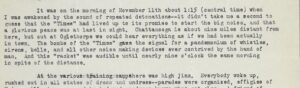
    paragraph from typewritten letter
    Excerpt from Gustav Patz’s letter to Earl Reed Silvers.

    After the war, Patz became a school principal. He died in 1953.


    The Rutgers War Service Bureau was formed in 1917 as a way to keep Rutgers men serving in the war in touch with Rutgers and each other. It was headed by Earl Reed Silvers (class of 1913), who was assistant to Rutgers president William Henry Steele Demarest. Thanks to a grant from the New Jersey Historical Commission, the letters are now available online.

    Be sure to visit What Exit? between November 1 and 11 for new stories and follow highlights on Special Collections and University Archives’ Facebook and Twitter.

    (With assistance from Tara Maharjan. Patz photo from the Rutgers University Biographical Files: Alumni Collection.)

  • Rutgers in the First World War: Voices of the Armistice—”The Ship Could Roll All it Wished”

    Facebooktwitterredditpinterestlinkedinmail

    November 11, 2018 is Veterans Day and marks the 100th anniversary of the Armistice that ended World War I. To commemorate this centennial, What Exit?  will be featuring letters from Special Collections and University Archives’ Records of the Rutgers College War Service Bureau. This collection features letters from Rutgers students and alumni who served in the First World War, describing their experiences serving in the United States and overseas. Each day between November 1 and 11, Voices of the Armistice posts will share what these Rutgers students from 100 years ago had to say about the moment when peace was declared.

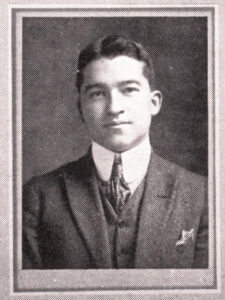
    photo of Lewellyn Pratt
    Lewellyn Pratt’s yearbook photo.

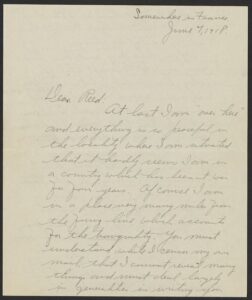
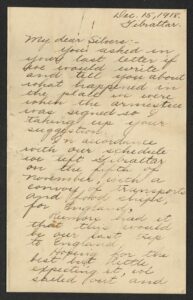
    Lewellyn Pratt (class of 1921) was serving with the American Expeditionary Forces. He had left Gibraltar and was traveling to England on a tossing ship when he learned of the Armistice that ended the war.

    Rumors had it that it would be our last trip to England.

    Hoping for the best, but little expecting it, we sailed out and encountered a heavy sea, which is very common along this coast.

    For four days along the coast of Spain and Portugal, we tossed and rolled, then the seas became somewhat calmer.

    Such a voyage is bound to make the crew more or less depressed and this time was no exception.

    Early in the morning of the eleventh, we had the news by press that the armistice was to be signed at eleven A.M.

    So accustomed to rumors, we little believed this to be true, but shortly after eleven we received the news and all the crew let forth a loud uproar of cheers.

    Depression was laid aside and enthusiasm reigned from bow to stern.

    The ship could roll all it wished now but no one could be down hearted after that.”

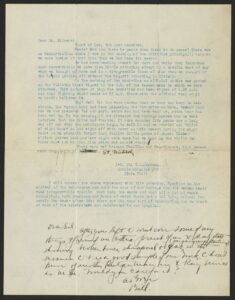
    Handwritten letter
    First page of Lewellyn Pratt’s letter to Earl Reed Silvers about the Armistice.

    Pratt became a counseling psychologist for the United States Veterans Administration. He died in 1958.


    The Rutgers War Service Bureau was formed in 1917 as a way to keep Rutgers men serving in the war in touch with Rutgers and each other. It was headed by Earl Reed Silvers (class of 1913), who was assistant to Rutgers president William Henry Steele Demarest. Thanks to a grant from the New Jersey Historical Commission, the letters are now available online.

    Be sure to visit What Exit? between November 1 and 11 for new stories and follow highlights on Special Collections and University Archives’ Facebook and Twitter.

    (With assistance from Tara Maharjan.  Pratt’s photo from the 1922 Rutgers College Yearbook.)

  • Rutgers in the First World War: Voices of the Armistice—”Work Went On As Usual”

    Facebooktwitterredditpinterestlinkedinmail

    November 11, 2018 is Veterans Day and marks the 100th anniversary of the Armistice that ended World War I. To commemorate this centennial, What Exit?  will be featuring letters from Special Collections and University Archives’ Records of the Rutgers College War Service Bureau. This collection features letters from Rutgers students and alumni who served in the First World War, describing their experiences serving in the United States and overseas. Each day between November 1 and 11, Voices of the Armistice posts will share what these Rutgers students from 100 years ago had to say about the moment when peace was declared.

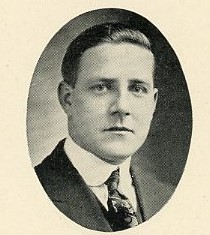
    J. H. Huntington’s yearbook photo.

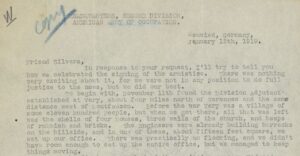
    J. H. [Jonathan Henry] Huntington (class of 1916) was serving with the American Expeditionary Forces in France when the Armistice was signed. He described his division’s response as mostly quiet, with brief—but emphatic—celebration.

    “There was nothing very exciting about it, for we were not in any position to do full justice to the news, but we did our best.

    To begin with, November 11th found the Division Adjutant established at Very, about four miles north of Varennes and the same distance west of Montfaucon. Before the war Very was a village of some eleven hundred people, but when we got there, all that was left was the shells of four houses, three walls of the church, and heaps of rubbish and bricks . . .

    The first news we had of the armistice came on Wednesday evening, when the Corps phoned that Germany was sending envoys to discuss the terms of an armistice. The news didn’t get around until the next day, but about four o’clock Thursday afternoon things broke loose. Pistols, rifles, flares and pyrotechnics were set off, and the cheering was tremendous. The celebration lasted about an hour.  

    From that time until we received orders over the phone that the armistice had been signed at five o’clock Monday morning, and the hostilities would cease at eleven, there was no demonstration at all. In fact, the news was received very quietly where we were, and work went on as usual.” 

    excerpt from typewritten letter
    Excerpt from letter by J. H. Huntington.

    After the war Huntington worked in life insurance. He died in 1974.


    The Rutgers War Service Bureau was formed in 1917 as a way to keep Rutgers men serving in the war in touch with Rutgers and each other. It was headed by Earl Reed Silvers (class of 1913), who was assistant to Rutgers president William Henry Steele Demarest. Thanks to a grant from the New Jersey Historical Commission, the letters are now available online.

    Be sure to visit What Exit? between November 1 and 11 for new stories and follow highlights on Special Collections and University Archives’ Facebook and Twitter.

    (With assistance from Tara Maharjan. Photo of Huntington from the Scarlet Letter 1917 Yearbook.)

  • Rutgers in the First World War: Voices of the Armistice—”A Good Night’s Sleep—Sure of a Peaceful Night”

    Facebooktwitterredditpinterestlinkedinmail

    November 11, 2018 is Veterans Day and marks the 100th anniversary of the Armistice that ended World War I. To commemorate this centennial, What Exit?  will be featuring letters from Special Collections and University Archives’ Records of the Rutgers College War Service Bureau. This collection features letters from Rutgers students and alumni who served in the First World War, describing their experiences serving in the United States and overseas. Each day between November 1 and 11, Voices of the Armistice posts will share what these Rutgers students from 100 years ago had to say about the moment when peace was declared.

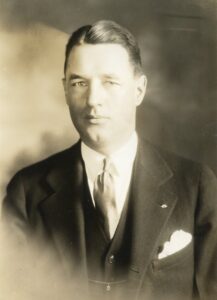
    photograph
    Photo of J. Kingsley Powell

    J. [John] Kingsley Powell (class of 1917) was serving with the American Expeditionary Forces in France when peace was declared on November 11, 1918. He described the experience of the Armistice in a letter to War Service Bureau director Earl Reed Silvers. His division had been in the thick of battle before another division was sent to relieve them.

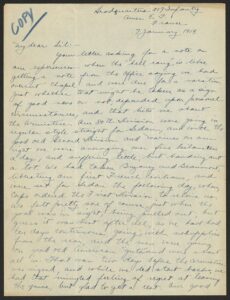
    “We felt pretty sore of course, just when the goal was in sight, being pulled out . . . the men were going on good old American “guts” and were about all in. That was two days before the armistice was signed and while we did start back, we had the mingled feeling of regret at leaving the game, but glad to get a rest.”

    On learning of the Armistice, Powell conveyed the news to his regiment:

    “. . . the doggondest thing about it, we all took the news about the same as we did ordinary routine orders! There was no fuss, no noise, and no change in our movements. We pulled into our camp and made ready for a night’s stop—just an incident in the game. When I look back and think of it, it seems remarkable. A few of the men shot off some pyrotechnics at night, and we had the band out later for a short time—that was all. I remember the occassion [sic] as a good night’s sleep—sure of a peaceful night.” 

    Page from handwritten letter
    First page of Powell’s letter.

    After the war, Powell became a realtor. He died in 1959.


    The Rutgers War Service Bureau was formed in 1917 as a way to keep Rutgers men serving in the war in touch with Rutgers and each other. It was headed by Earl Reed Silvers (class of 1913), who was assistant to Rutgers president William Henry Steele Demarest. Thanks to a grant from the New Jersey Historical Commission, the letters are now available online.

    Be sure to visit What Exit? between November 1 and 11 for new stories and follow highlights on Special Collections and University Archives’ Facebook and Twitter.

    (With assistance from Tara Maharjan. Powell photo from the Rutgers University Biographical Files: Alumni Collection.)
  • Rutgers in the First World War: Voices of the Armistice—”It Really Wasn’t Such a Tough Old World After All”

    Facebooktwitterredditpinterestlinkedinmail

    November 11, 2018 is Veterans Day and marks the 100th anniversary of the Armistice that ended World War I. To commemorate this centennial, What Exit?  will be featuring letters from Special Collections and University Archives’ Records of the Rutgers College War Service Bureau. This collection features letters from Rutgers students and alumni who served in the First World War, describing their experiences serving in the United States and overseas. Each day between November 1 and 11, Voices of the Armistice posts will share what these Rutgers students from 100 years ago had to say about the moment when peace was declared.

    Donald Malven, class of 1919, was serving with the American Expeditionary Forces in France when peace was declared on November 11, 1918. He wrote to War Service Bureau director Earl Reed Silvers:

    On the day the armistice was signed we were hiking back from the front for rest and, altho we didn’t hear of the real signing of the armistice till evening, we knew that there were rumors that it would be signed. After we had pitched our pup tents for a cold, wet night of it, suddenly the bugle blew attention and the news was read to us.  

    Then our Band which joined us that night played “Home Sweet Home” and we began to celebrate. We all built big roaring bonfires, (the first we’d had in ages) in front of our own pup tents. We dried out and got warm and thou’t that it really wasn’t such a tough old world after all.”

    Four lines of handwritten text
    Excerpt from page 2 of Donald Malven’s letter.

    The Rutgers War Service Bureau was formed in 1917 as a way to keep Rutgers men serving in the war in touch with Rutgers and each other. It was headed by Earl Reed Silvers (class of 1913), who was assistant to Rutgers president William Henry Steele Demarest. Thanks to a grant from the New Jersey Historical Commission, the letters are now available online.

    Be sure to visit What Exit? between November 1 and 11 for new stories and follow highlights on Special Collections and University Archives’ Facebook and Twitter.

    (With assistance from Tara Maharjan.)


  • Rutgers in the First World War: Voices of the Armistice—”Too Busy to Celebrate”

    Facebooktwitterredditpinterestlinkedinmail

    November 11, 2018 is Veterans Day and marks the 100th anniversary of the Armistice that ended World War I. To commemorate this centennial, What Exit?  will be featuring letters from Special Collections and University Archives’ Records of the Rutgers College War Service Bureau. This collection features letters from Rutgers students and alumni who served in the First World War, describing their experiences serving in the United States and overseas. Each day between November 1 and 11, Voices of the Armistice posts will share what these Rutgers students from 100 years ago had to say about the moment when peace was declared.

    photograph of William Herrmann
    Photo of William Herrmann.

    On November 11, 1918 William Herman, class of 1912 was serving with a Mobile Hospital unit in France. When the War Service Bureau inquired about his experiences when peace was declared, he responded:

    “Peace? How can there be peace when there is no peace? There was no demonstration where I was on the morning of the armistice principally because we were busier at the time than we had been for weeks. . .

    On the morning of the armistice an official notice was posted on the bulletin board signed by the C.O. of the second army to which we were attached. This informed us that the armistice had been signed at 5:30 A.M. and that fighting would ceace [sic] at 11 A.M. Even with the official seal on it we hardly believed it.  

    Why? Well for the same reason that we were too busy to celebrate. The second army had been preparing for its drive on Metz. We knew that and we had prepared for our part, extra men had been sent us, extra beds had been set up. On the morning of the eleventh the barrage opened and we were informed that the drive had started. It sure sounded like peace was a long way off and when the ambulances began to toll in and we started our shifts of eight hours on and eight off with never an idle moment during the eight hours on we promptly forgot that foolish little peace [sic] of paper. Eleven o’clock proved headquarters right once more but we kept up the shift for three days and by that time peace was an old story.”

    typewritten letter with handwritten note at bottom
    William Herrman’s letter about Armistice in France.

    Herrman was a doctor specializing in radiology. He died in 1965.


    The Rutgers War Service Bureau was formed in 1917 as a way to keep Rutgers men serving in the war in touch with Rutgers and each other. It was headed by Earl Reed Silvers (class of 1913), who was assistant to Rutgers president William Henry Steele Demarest. Thanks to a grant from the New Jersey Historical Commission, the letters are now available online.

    Be sure to visit What Exit? between November 1 and 11 for new stories and follow highlights on Special Collections and University Archives’ Facebook and Twitter.

    (With assistance from Tara Maharjan. Herrman photo from the Rutgers University Biographical Files: Alumni Collection.)
     

  • Rutgers in the First World War: Voices of the Armistice—”New Year’s Eve in New York [and] a Couple of Mardi Gras”

    Facebooktwitterredditpinterestlinkedinmail

    November 11, 2018 is Veterans Day and marks the 100th anniversary of the Armistice that ended World War I. To commemorate this centennial, What Exit?  will be featuring letters from Special Collections and University Archives’ Records of the Rutgers College War Service Bureau. This collection features letters from Rutgers students and alumni who served in the First World War, describing their experiences serving in the United States and overseas. Each day between November 1 and 11, Voices of the Armistice posts will share what these Rutgers students from 100 years ago had to say about the moment when peace was declared.

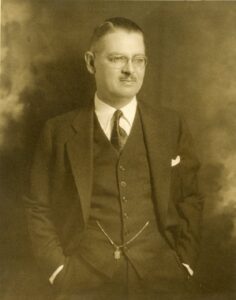
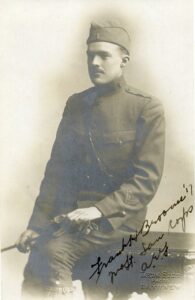
    Photo of Frank Broome in uniform
    Frank Broome

    On November 11, 1918 Frank Broome (class of 1917) was serving in the U.S. Sanitary Corps. as part of the American Expeditionary Forces in France. He felt that nothing could adequately capture the celebration he witnessed when peace was declared.

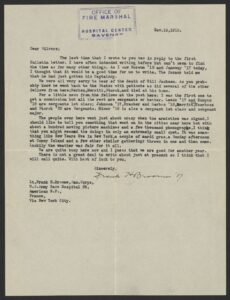
    “The people over here went just about crazy when the armistice was signed, I should like to tell you something that went on in the cities near here, but with about a hundred moving picture machines and a few thousand phonographs, I think that you might record the doings in only an extremely small spot. It was something like New Years Eve in New York, a couple of mardi gras, a Sunday afternoon at Coney Island and a few other similar gatherings thrown in one and then some. Luckily the weather was fair for it all.”

    typed letter
    Letter from Frank Broome describing end of First World War.

    After the war, Broome became an educator and inventor. He died in 1940.


    The Rutgers War Service Bureau was formed in 1917 as a way to keep Rutgers men serving in the war in touch with Rutgers and each other. It was headed by Earl Reed Silvers (class of 1913), who was assistant to Rutgers president William Henry Steele Demarest. Thanks to a grant from the New Jersey Historical Commission, the letters are now available online.

    Be sure to visit What Exit? between November 1 and 11 for new stories and follow highlights on Special Collections and University Archives’ Facebook and Twitter.

    (With assistance from Tara Maharjan. Broome photo from the Rutgers University Biographical Files: Alumni Collection.)

  • Rutgers in the First World War: Voices of the Armistice—”A Kind of Super-Halloween Celebration”

    Facebooktwitterredditpinterestlinkedinmail

    November 11, 2018 is Veterans Day and marks the 100th anniversary of the Armistice that ended World War I. To commemorate this centennial, What Exit?  will be featuring letters from Special Collections and University Archives’ Records of the Rutgers College War Service Bureau. This collection features letters from Rutgers students and alumni who served in the First World War, describing their experiences serving in the United States and overseas. Each day between November 1 and 11, Voices of the Armistice posts will share what these Rutgers students from 100 years ago had to say about the moment when peace was declared.

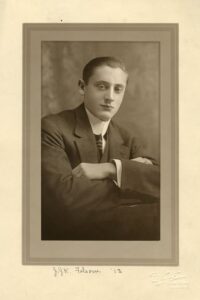
    photograph of Joseph K. Folsom
    Joseph K. Folsom.

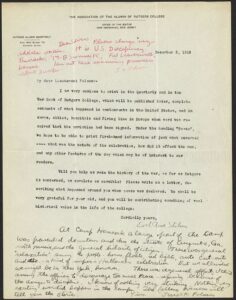
    Joseph K. Folsom (class of 1913) was stationed at Camp Hancock in Augusta, Georgia, on November 11, 1918. When he received War Service Bureau director Earl Reed Silvers’s letter asking for information about “what happened around you when peace was declared.” Folsom wrote a brief paragraph on Silvers’s letter itself saying:

    “At Camp Hancock a large part of the camp was paraded downtown and thro the streets of Augusta, Ga. with music, and the general hilarity of citizens. There was general ‘relaxation’ among the people—horns, floats, red lights, auto cut-outs and etc.—a kind of super-Halloween celebration. But we all wished we might be in New York, however. There was a general effort, I think among the officers to discourage too much peace-rejoicing, because of the danger to discipline. I know of nothing very striking. Nothing very exciting ever did happen in the camps. The fellows overseas will tell you the stories.”

    typed letter with handwritten response.
    Joseph K. Folsom’s response to Silvers’s inquiry about the end of the war.

    After the war, Folsom became a professor of sociology at Vassar College in Poughkeepsie, New York. He died in 1960.


    The Rutgers College War Service Bureau was formed in 1917 as a way to keep Rutgers men serving in the war in touch with Rutgers and each other. It was headed by Earl Reed Silvers (class of 1913), who was assistant to Rutgers president William Henry Steele Demarest. Thanks to a grant from the New Jersey Historical Commission, the letters are now available online.

    Be sure to visit What Exit? between November 1 and 11 for new stories and follow highlights on Special Collections and University Archives’ Facebook and Twitter.

    (With assistance from Tara Maharjan. Folsom photo from the Rutgers University Biographical Files: Alumni Collection.)

  • Rutgers in the First World War: “Voices of the Armistice” November 1–11, 2018

    Facebooktwitterredditpinterestlinkedinmail

    November 11, 2018 is Veterans Day and marks the 100th anniversary of the Armistice that ended World War I. To commemorate this centennial, What Exit?  will be featuring letters from Special Collections and University Archives’ Records of the Rutgers College War Service Bureau. This collection features letters from Rutgers students and alumni who served in the First World War, describing their experiences serving in the United States and overseas. Each day between November 1 and 11, Voices of the Armistice posts will share what these Rutgers students from 100 years ago had to say about the moment when peace was declared.

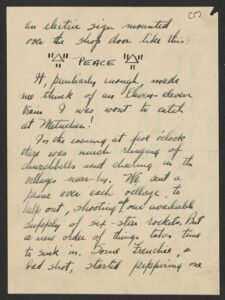
    Joseph K. Folsom (class of 1913), was stationed in Georgia on November 11, 1918 and described a “kind of super-Halloween celebration” with a noisy parade and “general hilarity.” Harry Blue (class of 1918) was stationed in France. He described taking a swooping celebratory flight in which he “missed electrical wires by inches.”

    page from letter describing sign comemmorating declaration of peace on November 11, 1918
    Page from letter by Harry Blue (class of 1915) describing his experiences of the Armistice that ended the First World War.

    The Rutgers War Service Bureau was formed in 1917 as a way to keep Rutgers men serving in the war in touch with Rutgers and each other. It was headed by Earl Reed Silvers (class of 1913), who was assistant to Rutgers president William Henry Steele Demarest. Thanks to a grant from the New Jersey Historical Commission, the letters are now available online.

    Be sure to visit What Exit between November 1 and 11 for new stories and follow highlights on Special Collections and University Archives’ Facebook and Twitter.


  • Rutgers in the First World War, May and June 1918—A World in Motion

    Facebooktwitterredditpinterestlinkedinmail

    When the United States entered World War I a century ago, Rutgers transformed into a war college focused on supporting America’s war effort. Many students and alumni joined the armed forces. Earl Reed Silvers, assistant to Rutgers president William H. S. Demarest, launched the Rutgers War Service Bureau as a means to keep in touch with Rutgers men in service. The Rutgers in the First World War series features stories from the War Service Bureau correspondence, offering a window on the impact of the war on Rutgers students and alumni 100 years ago.

    At Rutgers: Baseball and Bombshells

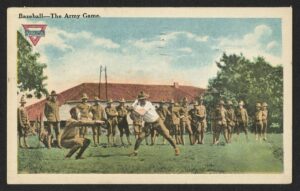
    Postcard showing men in uniform playing baseball, captioned "Baseball--the Army Game." Postcard has a YMCA--Young Men's Christian Association--logo.
    A postcard sent by Harold Faint (class of 1917) in late May 1918


    The May 1918 War Service Bureau letters to men in service brought news of baseball and commencement activities at Rutgers.  On May 20, Silvers wrote about a game taking place that afternoon.

    This afternoon we play Lafayette in baseball. . . . Johnny Lyons, our baseball captain, has gone to the Fourth Officers’ Camp; and so we’re not very optimistic about the result of the game this afternoon.

    Silvers reported that the number of graduates for the 1918 commencement was down due to men leaving Rutgers to serve. Although he was sure the previous year had 77 graduates, he stated the class of 1918 had 42 graduates in his May 20 letter, but his June 5 letter changed the number to 47 (according to the 1918 commencement program, the number should be 46). Some Rutgers men in service had returned to visit for commencement. In the May 20 letter, Silvers describes one such man bringing a souvenir:

    “Bob Searle is here in uniform from Camp Devens. He brought with him an unexploded four-inch shell and my stenographer is in deadly fear of being blown to atoms.

    In his June 5 letter, Silvers followed up on this alarming gift to reassure the men

    “That shell of Bob Searle’s which almost scared our stenographer to death wasn’t loaded, after all.”

    From the Men: The Hazards and Pleasures of Travel

    Rutgers men in service wrote to the Bureau in May and June 1918 to describe their travels overseas.

    On May 1, 1918, August Grimme (class of 1918) wrote from the north of England.

    “I am now located at a Gunnery School . . . The work is interesting and I enjoy it very much. The weather is rather uncomfortable up here. It seems almost like January. In fact we had a little snow flurry this morning.

    Reverend Maurice Kain’s (class of 1906) May 18, 1918 letter waxed poetic in its description of France (his correspondence folder does indeed contain a poem about France).

    France is remarkably colorful at this present springtime. The skylark wakes one morning. Blooming lilac hedges, surround him. Fertile fields lie beyond. But the more or less distant boom of guns, and the homing flight of flocks of airplanes tell one that farther beyond is —red war, red but glorious; or rather, glorious because red.

    On June 7, 1918 William P. E. Ainsworth (class of 1916) wrote of some rockiness on an otherwise calm ocean crossing to Europe,

    “The trip over was wonderful. The sea was calm and the weather beautiful all of the way, except for about two days when it blew rather rough, and, as the seas caught us sideways, the boat rocked to beat the band. It sometimes rocked so that for hours, if you were sitting on deck, you were looking alternately at the sky above and the water beneath you, and unless you braced your steamer chair you would slide, chair and all, across the deck. Many of the men were dreadfully seasick, but it did not affect me in the least; in fact, I thoroughly enjoyed it.”

    First page of handwritten letter, dated June 7, 1918, written from "Somewhere in France."
    First page of Ainsworth’s June 7, 1918 letter. Transcribed version also available.


    On June 26, 1918 Stuart M. Firth (class of 1914) described other watery travels on French soil (transcribed version also available).

    “When we marched forty two days to take over our sector, we were accompanied for the forty-eight hours by the most generous supply of rain and snow and hail that this country could give. For two solid days everyone was wet to the skin. Raincoats were not more effective than blotting paper; trench boots, guaranteed to be waterproof when bought in the States, absorbed the bountiful liquid like a sponge.”

    Despite these conditions, Firth maintained

    “not a man grumbled, there was joking and laughing up and down the whole line and plenty of good old American cussing that did your heart good to listen to.”

    [with assistance from Tara Maharjan]

    To Learn More

    The Rutgers College War Service Bureau collection has been digitized with assistance by a grant from the New Jersey Historical Commission, a division of the Department of State. A finding aid describing collection is available and provides links to the digitized materials. 

    *The commencement program for 1918 lists 46 graduates.

What Exit?

News and information about holdings, events, acquisitions, and New Jerseyana at the Department of Special Collections and University Archives, Rutgers University Libraries, New Brunswick

Follow Us

Categories

Recent Posts

Tags

Anglo-Dutch wars cookbooks Cornelius Van Horne digitization Dinah van Bergh Hardenbergh Dutch records Dutch slave owners election cake farm ledgers Frelinghuysen Family Great War Hardenbergh Familie Hebrew herbals Jacob Rutsen Hardenbergh Johannes G. Hardenbergh manuscripts New Brunswick New Brunswick Music Scene Archive New Jersey Dutch NJ Soldiers Pictorial collection Postcard Collection Scarlet and Black Sinclair NJ Cookbook Collection Soujourner Truth Theodorus Jacobus Frelinghuysen Trenton Ukawsaw Gronniosaw Ulster County NY World War I